A rooflight should make an extension feel brighter, more open and more connected to the sky. But its glass also becomes one of the most exposed parts of the roof. A proper rooflight glass performance review looks beyond the view, helping you balance daylight, warmth, summer comfort, privacy and safety before committing to a design.
For a kitchen extension, orangery or renovated living space, the right specification can make a visible difference every day. The wrong one may leave a room that is too warm on sunny afternoons, colder near the roof in winter, or harder to keep comfortable than expected.
What rooflight glass has to do
Roof glazing works harder than vertical windows. It receives more direct sun, sits at an angle where rain and debris behave differently, and can account for a meaningful portion of heat gain and heat loss in a flat-roof extension. This does not mean rooflights are inefficient by nature. It means the frame, glass build-up, size, orientation and installation all need to be considered together.
Most quality flat roof lights use insulated double glazing, often with a specialist coating designed to improve thermal performance. The glass unit may also include laminated safety glass, solar-control glass or a combination of these features. Each option addresses a different concern, so there is rarely one specification that suits every property.
Thermal performance: look beyond one number
The U-value measures how readily heat passes through a product. Lower figures indicate better insulation. When comparing rooflights, ask whether the quoted value relates to the glass alone, the centre of the glass, or the complete rooflight including its frame. These are not interchangeable figures.
A well-designed aluminium rooflight uses a thermally broken frame. The thermal break reduces the route by which heat can travel through the aluminium, while energy-efficient glazing helps retain warmth inside. This combination is particularly valuable in extensions with large areas of glazing, where comfort depends on every element working together.
That said, chasing the lowest possible U-value is not the only decision. A heavily shaded north-facing room may benefit from prioritising insulation and maximum daylight. A south-facing glazed extension may need stronger solar control, even if it slightly changes the appearance of the glass or reduces the amount of light passing through it.
Edge performance matters too
The perimeter of an insulated glass unit is often its weakest thermal point. A warm-edge spacer helps reduce heat loss around the edge of the pane and can lower the likelihood of internal condensation. It is a small component, but it supports a more consistent internal surface temperature across the glass.
Condensation should not be judged on glass alone. High indoor humidity from cooking, showers or drying clothes, limited ventilation and cold surfaces can all contribute. A correctly specified rooflight helps, but good background ventilation remains essential in a modern, well-insulated home.
Solar control: preventing the greenhouse effect
The main trade-off with overhead glazing is solar gain. A rooflight can introduce much more direct sunshine than a similarly sized vertical window, especially when the roof faces south or west. This is welcome on a bright spring morning, but it can become uncomfortable in a kitchen extension during prolonged summer heat.
Solar-control glass is designed to reduce the amount of solar energy entering the room while allowing useful daylight through. It is often a sensible choice for large rooflights, shallow extensions with limited cross-ventilation, and rooms with extensive south- or west-facing glazing such as bifold or sliding doors.
The key figure is the g-value, also called the solar factor. A lower g-value means less solar energy passes through the glazing. Lower is not automatically better. If a room is shaded by neighbouring buildings, mature trees or a north-facing aspect, very strong solar control may make it feel unnecessarily dim. The best choice depends on orientation, rooflight size, the room beneath it and how the space will be used.
Blinds can reduce glare, but they usually address the issue after heat has already entered the room. Glass that manages solar gain at the outset is generally the stronger starting point. External shading can be highly effective too, although it changes the rooflight’s appearance and adds another product to maintain.
Daylight and clarity: brightness without harsh glare
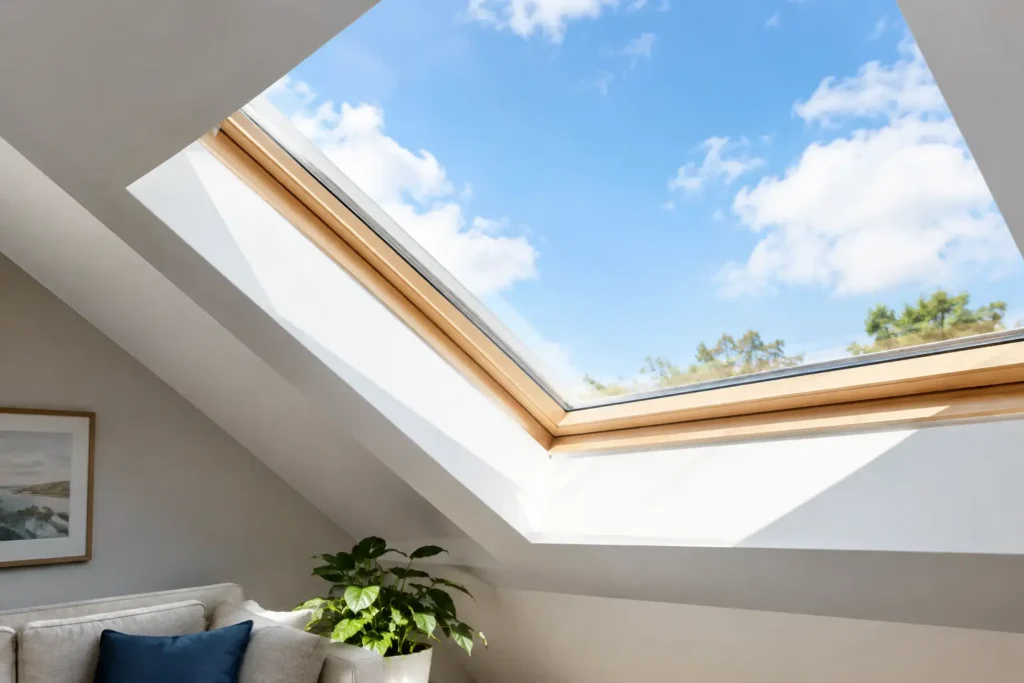
Homeowners often choose rooflights because daylight reaches further into a room from above. This can transform the centre of a deep extension, where light from garden doors alone may not be enough. A slim-framed, fixed flat roof light can create a clean architectural finish while bringing clear sky views into the space.
Visible light transmittance indicates how much daylight passes through the glass. Higher transmission supports a brighter interior, but it must be balanced with solar control and glare reduction. Clear glass is not always the best performer in a sun-exposed room.
Rooflight positioning is just as important as the glazing specification. One large unit can make a striking feature, while two smaller rooflights may spread daylight more evenly along the length of an extension. Consider where the kitchen island, dining table and seating area will sit. Direct overhead sun above a worktop can cause glare, whereas daylight over a circulation area may be more useful and easier to manage.
Safety, security and everyday durability
Overhead glazing must be safety glass. In practical terms, this commonly means toughened glass, laminated glass, or a specified combination suited to the rooflight design. Laminated inner panes are often valued because, if the glass breaks, the interlayer helps hold fragments in place rather than allowing them to fall into the room.
A rooflight must also withstand wind loads, snow loads and the everyday weather experienced by its location. A product should be designed, manufactured and installed for the particular roof opening rather than selected on size alone. Large panes are heavier, and the supporting roof structure and kerb detail must be able to carry them correctly.
For security, fixed rooflights benefit from being difficult to access and from using secure glazing and a strong frame. Opening rooflights need equally careful consideration of locking, weather seals and operation. An opening unit can help purge warm air, but it introduces moving parts and should be chosen where the ventilation benefit is worthwhile.
A rooflight glass performance review: questions to ask
Before accepting a quotation, ask for the full glazing specification in plain English. You should understand the overall U-value, the glass safety construction, whether a low-emissivity coating is included, and whether solar-control glass is recommended for your aspect.
Also ask how the rooflight will be installed into the roof build-up. A high-performing glass unit cannot compensate for a poorly formed upstand, inadequate insulation around the opening or weak waterproofing details. The rooflight, kerb, roof membrane and internal finish must work as one system.
It is also worth checking the external and internal frame colours. Dark frames can give a sharp contemporary outline and work particularly well alongside aluminium systems such as Smarts Visofold 1000 Bifold Doors. However, the finish should complement the wider scheme rather than competing with it. A rooflight is seen from above and below, so both views count.
Choosing the right balance for your extension
For a compact north-facing extension, a clear, thermally efficient glass specification may be the most practical route to greater brightness. For a large south-facing kitchen with wide garden doors, solar-control glazing and planned ventilation are likely to matter more. For a bedroom or bathroom, privacy, ventilation and control of early-morning light may shape the decision.
Do not treat glass as an add-on to the rooflight frame. It is central to how the room feels in January, during a July heatwave and on an ordinary overcast afternoon. A tailored specification gives you the best chance of gaining the light and sense of space you want, without sacrificing the comfort that makes an extension enjoyable to live in.