A window can have a beautifully slim aluminium frame, excellent glazing and a contemporary finish, yet still fall short if the locking and hinge hardware is poorly specified. This window security hardware review looks at the parts that do the real work when a window is shut: the locks, handles, hinges, restrictors and glass retention systems that protect your home without compromising light or design.
For a replacement window, extension or whole-house renovation, security should be assessed as part of the complete window system. A reassuring handle on its own is not evidence of a secure window. The quality of the frame, the number and position of locking points, how the sash is hung and the glazing specification all matter.
What good window security hardware should do
Good hardware makes forced entry difficult, time-consuming and conspicuous. It should also work reliably for years, close neatly without excessive pressure and allow the window to provide safe ventilation. For homeowners, that means security and everyday usability should sit together rather than competing.
On a quality aluminium window, the hardware is engineered to work with the profile. Locking points should engage positively into keeps fixed to the frame, while the sash should remain properly aligned as it opens and closes. Aluminium is particularly well suited to this because its strength helps it retain precise lines and resist warping over time, provided the system is manufactured and installed correctly.
Look beyond broad claims such as “high security” and ask how the window achieves it. A supplier should be able to explain the lock type, the hinge arrangement, whether key locking is included, and the security testing or standard the full window has been designed to meet.
Window security hardware review: the essential components
Multi-point locking systems
Most modern casement windows use an espagnolette locking system. Operated by the handle, it moves locking points along the edge of the opening sash so the window locks into the frame at several positions rather than just one.
This is a major improvement on older single-point catches. It spreads resistance around the sash, making it harder to force a corner open with a tool. The exact number of locking points is not the whole story: their placement, the strength of the keeps and the accuracy of manufacture are equally important. On a larger opening sash, there is a stronger case for multiple well-positioned points to maintain even compression and security.
For the best results, choose a system with secure locking points and durable keeps designed specifically for the window profile. Poorly fitted keeps can leave a sash loose or prevent it closing properly, which affects both security and weather performance.
Locking handles
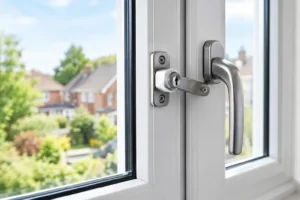
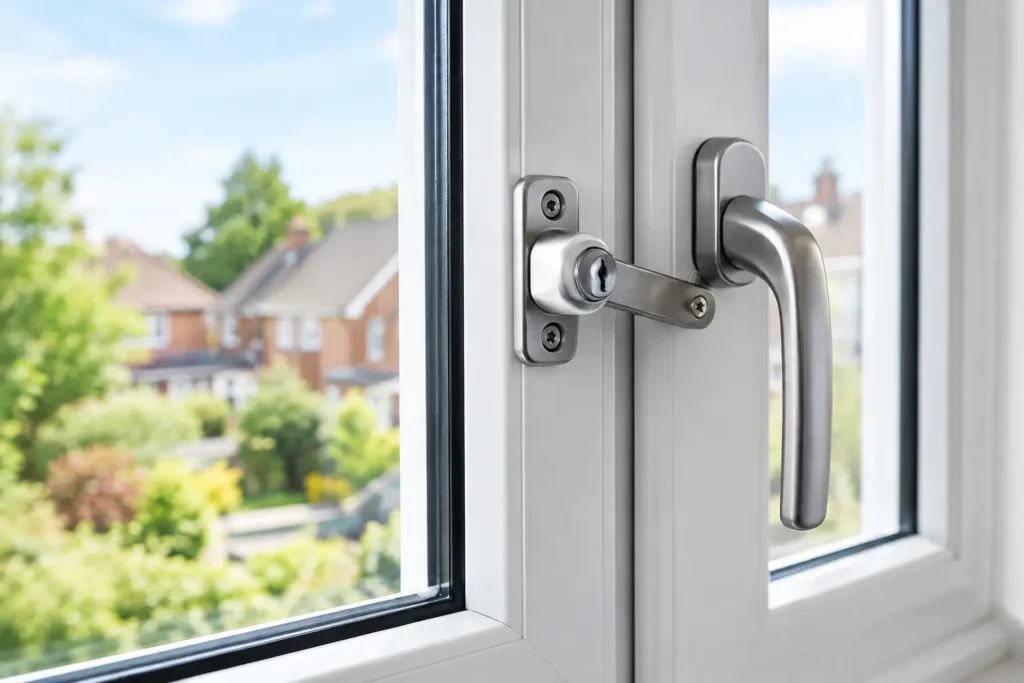
The handle is the part you touch every day, but it is also the control point for the lock. Key-locking handles are a sensible choice for accessible ground-floor windows, windows close to flat roofs, and openings near gates or side passages. They can prevent an intruder from simply operating the handle after breaking a pane.
A key lock does not make weak glass or weak locking points secure by itself. It is one layer in a wider design. It can, however, offer valuable reassurance in family homes, particularly where windows may be left on a ventilation setting.
Handle quality matters aesthetically too. A well-made handle should feel solid, operate smoothly and suit the finish of the window. Black, white, anthracite grey and metallic hardware can all complement aluminium frames, but security performance should never be sacrificed for a particular appearance.
Hinges and hinge-side protection
Hinges are often overlooked because they sit on the opposite side of the sash from the handle. Yet if a window opens outwards, the hinge side must resist attack just as effectively as the locking side.
High-quality friction hinges support the sash evenly and help prevent dropping, which can otherwise affect lock engagement. Security hinges may incorporate features that resist levering or prevent the sash from being lifted away when shut. The right specification depends on the window style, size, weight of the glazing and whether it opens in or out.
This is one reason bespoke manufacture is valuable. A large, glazed casement window needs hardware chosen for its actual dimensions and weight, not a generic arrangement applied to every opening.
Restrictors for safe ventilation
Window restrictors limit how far a sash can open. They are particularly useful upstairs, in children’s bedrooms and in rooms where an open window could create a fall risk. They can also allow controlled airflow without leaving a wide opening that is easier to access from outside.
A restrictor is not automatically a security device. Some are intended primarily for safety and may release easily for cleaning or escape. Where security is a concern, ask how the restrictor operates, whether it locks, and whether the window has a secure night-vent position. The correct solution will depend on the room and the window’s location.
Security is about the glass and frame as well
Hardware cannot be considered in isolation. If an intruder can remove the glass or force the sash from the frame, a strong lock has limited value. The glass should be properly supported and retained within the sash, with beads positioned on the secure side where appropriate.
Toughened safety glass is often used where there is a risk of impact, while laminated glass can add a further barrier because its interlayer helps hold the pane together after breakage. Laminated glass can be especially worth discussing for easily accessible windows, but it has cost and weight implications. Heavier units may require different hinge or sash specifications, so the whole window must be designed accordingly.
The frame, sash, glazing beads, locks and fitting all need to perform as one tested assembly. This is why comparing a list of individual components is less useful than understanding the overall system.
Standards worth asking about
For UK homeowners, PAS 24 is a useful benchmark to discuss. It relates to enhanced security performance for doors and windows and considers methods of attack intended to mimic opportunistic break-in attempts. A PAS 24-tested window provides more meaningful reassurance than a product described only as “secure”.
Secured by Design is another recognised police-backed initiative that may be relevant, especially for new-build projects or homeowners aiming for a particular security specification. Not every renovation requires it, and suitability depends on the product and project, but it is a worthwhile question to raise.
Building Regulations cover several issues beyond security, including safety glazing and means of escape. For example, a bedroom escape window must provide an adequate opening in the correct location. Adding a restrictor or choosing an opening configuration without considering escape requirements can create a problem. An experienced supplier or installer should help balance these requirements from the outset.
Where homeowners can make better choices
The most effective specification starts with how each window will be used. A first-floor bathroom window behind a private garden may need a different approach from a ground-floor kitchen window beside a public footpath. Accessible rear elevations, side passages, flat roof access and windows near a garage roof deserve particular attention.
There are four practical questions to ask before ordering:
- Does the complete window system meet an appropriate recognised security standard, such as PAS 24 where required or preferred?
- Are key-locking handles, multi-point locks and hinge-side protection included in the quoted specification?
- Is the glass suitable for the window’s location, including any need for safety or laminated glass?
- Will restrictors, ventilation positions and fire escape needs work together properly?
It is also sensible to confirm what is included in a supply-only quote versus an installation package. Even excellent hardware depends on precise installation. The frame must be fixed securely, packed correctly and adjusted so every locking point engages as intended. A window that catches, needs forcing shut or has visible gaps should be checked rather than accepted as normal.
Aluminium windows: security without heavier sightlines
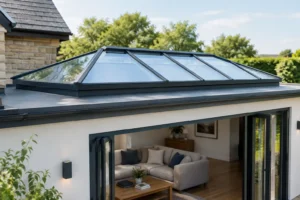
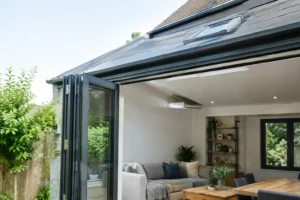
Modern aluminium systems give homeowners a strong route to secure, light-filled glazing. Products such as Smarts Alitherm 400 Windows, Cortizo Casement Windows and Schuco AWS80SC Casement Windows can be configured with slim sightlines, thermal breaks and high-performance hardware suited to contemporary extensions and replacement projects.
The right choice is not simply the window with the longest feature list. A large garden-facing opening may prioritise a slim frame and a carefully designed locking arrangement, while a smaller side window may benefit from a restricted opening and laminated glass. Bespoke colours, handle finishes and opening styles can then be selected around a sound security specification rather than used to disguise a weak one.
When requesting a quotation, ask for the security hardware to be described in plain English, not hidden under a vague line item. A well-specified aluminium window should make your home brighter and more comfortable while giving you confidence every time you turn the handle.