
Standing in a new extension opening and trying to choose between sliding patio doors or bifold is where plenty of good renovation plans stall. Both look smart. Both bring in more light than older French doors. But they behave very differently once they are fitted, and the right answer usually comes down to how you want the room to work every day, not just how it looks in a brochure.
If you are upgrading a kitchen-diner, opening up a garden room or planning a rear extension, this choice affects far more than appearance. Sightlines, traffic flow, furniture layout, threshold options, thermal performance and even how often you will actually open the doors all matter. That is why it helps to compare them in practical terms.
Sliding patio doors or bifold – what is the real difference?
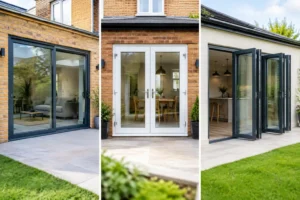
The simplest way to think about it is this: sliding doors move behind one another on a track, while bifold doors fold and stack to one or both sides. That changes the whole feel of the opening.
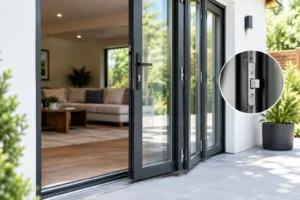
A sliding system gives you larger uninterrupted panes of glass and slimmer vertical lines across the view. Products such as the Smarts Visoglide Plus sliding door or Cortizo COR Vision Sliding Door are popular for that reason. They suit homeowners who want a clean, contemporary look and a strong visual connection to the garden, even when the doors are shut.
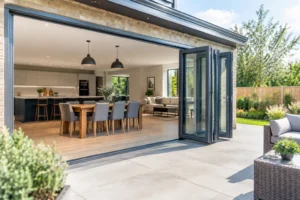
Bifold doors break the opening into multiple glazed panels that concertina back. Systems such as Smarts Visofold 1000 Bifold Doors, Schuco ASFD75 Bifold doors and Cortizo Bifold Plus are designed to open up a much larger proportion of the aperture. If your priority is making the inside and outside feel more connected in warm weather, bifolds have a clear advantage.
Neither option is better in every setting. The better choice depends on whether you value open access or uninterrupted glass more.
When sliding doors make more sense
Sliding patio doors are often the stronger option where the view is the star of the room. If you back onto a landscaped garden, countryside or a carefully designed patio, larger glass panels give you more to look at and less frame to interrupt it. Even on a grey January afternoon, that extra glazed area can make the room feel brighter and calmer.
They are also a sensible choice where space is tight. Because the panels slide within their own frame, there is no leaf swinging into the room or stacking internally or externally. That gives you more freedom with dining tables, kitchen islands and sofas near the opening. In compact extensions, that can be the difference between a room that feels easy to use and one that feels compromised.
There is also a practical point around day-to-day use. Many households do not fully open the rear doors every day of the year. They might crack one panel open for ventilation, or open half the aperture in summer. Sliding doors are very good at that kind of everyday convenience. You move one panel, get access to the garden, and leave the rest of the glazed wall undisturbed.
For wider openings, premium systems such as the Schuco ASE60 Sliding Door, Schuco ASE80 Sliding Door and Cortizo COR Vision Plus Sliding Door can create a very polished architectural finish. They work particularly well in modern extensions with level flooring and a minimal aesthetic.
Where bifold doors have the edge
Bifold doors come into their own when the aim is to open the room up properly. If you entertain often, have children moving in and out to the garden, or want summer living that spills naturally onto a patio, bifolds are hard to beat. Once folded back, they can leave most of the opening clear rather than only part of it.
That makes a real difference in family homes. A kitchen opening straight onto a terrace or garden feels more connected when there is a broad, unobstructed route outside. The same is true for orangery-style spaces and rear extensions built around hosting.
Bifolds also offer flexibility in configuration. You can choose the number of panels, the direction they stack, and whether to include a traffic door for quick access. That is useful if you want the convenience of a standard everyday entrance without opening the full set each time. Systems including Smarts Visofold 6000 Bifold Doors, ASFD90.Hi Bifold Doors and Origin OB49 Bifold Doors can be tailored to suit different opening widths and performance targets.
There is a visual trade-off, though. Because bifolds have more panels and more frame lines, they do not give the same uninterrupted outlook as sliding doors. From inside the house, you will see more vertical sections in the view.
Space, layout and how the room actually works
This is where many buying decisions are made.
If your furniture needs to sit close to the opening, sliding doors are usually easier to plan around. They stay within their own footprint, so there is less risk of a door leaf clashing with a dining chair, breakfast bar or outdoor furniture. That simplicity appeals to homeowners who want clean lines and a straightforward layout.
Bifolds need stacking space. When open, the panels gather at the side, and although that stack is neat, it still takes up room. In some designs, that is no issue at all. In others, especially where every millimetre counts, it needs careful thought.
Thresholds matter too. Both door types can be specified with low threshold options to improve access and create a more flush transition. If ease of movement is important – for children, older family members or simply carrying food and drinks outside – that detail is worth discussing early rather than treating it as a finishing touch.
Thermal efficiency and comfort indoors
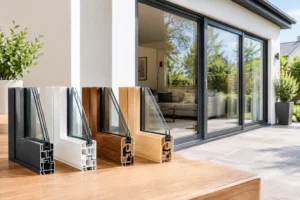
Homeowners often worry that large glazed doors will make a room colder. With well-made aluminium systems, that is no longer the old story. Aluminium products with a thermal break and energy efficient glazing can achieve strong thermal performance while still delivering slim, contemporary frames.
The more useful question is not whether sliding or bifold doors can be thermally efficient, because both can be. It is whether the system you choose is built to the right specification, installed properly and matched to the way the opening will be used. Frame design, glazing specification, weather seals and fitting quality all play a part.
That is one reason many buyers prefer established systems rather than generic alternatives. Good aluminium door ranges are engineered to meet current standards without asking you to compromise on style.
Security, durability and long-term value
Security should be standard, not an upgrade. High-quality aluminium sliding and bifold systems are designed with multi-point locking, durable hardware and strong frame construction. For most homeowners, the right question is not which format sounds more secure in theory, but whether the product itself is tested, compliant and fitted correctly.
Durability is another area where aluminium performs well. It is stable, low maintenance and well suited to large glazed openings. That matters over time. Rear doors get used hard, especially in busy family homes, and you want a system that keeps operating smoothly through the seasons.
Value is a little more nuanced. Sliding doors can be excellent value where you want large panes and a premium look with fewer moving parts. Bifolds can offer better lifestyle value if opening the whole space is central to how you will use the room. Cost should be judged against function, not just the headline quote.
Which style suits your home?
Contemporary extensions often lean naturally towards sliding doors because the minimal frame lines complement modern brickwork, rendered walls and large-format flooring. If your project is designed around a sleek rear elevation and long garden views, that pairing usually feels right.
Bifolds are still a strong fit for modern homes, but they also work well in more mixed styles of property because their panelled appearance can feel slightly more familiar. In practical family renovations, they often win because they make the opening more usable in summer.
If you are torn, think about the room in February as well as August. If you mostly want light, outlook and a refined glazed wall, sliding doors may suit you better. If you want the opening itself to become part of the living space in warmer months, bifolds may earn their place.
The best choice is usually the one matched to the opening
There is no single winner in the sliding patio doors or bifold debate because not every extension asks the same thing from the glass. A wide opening with a view may call for a sliding system. A social kitchen with regular garden access may benefit more from bifolds. Some homeowners even choose sliding doors for one room and bifolds elsewhere to suit different uses across the home.
At Smarts Bifold Doors, this is exactly why bespoke specification matters. Panel sizes, colours, hardware finishes, threshold details and installation requirements all influence the final result just as much as the broad category of door.
The right door should look right on day one, feel right in winter, and still suit the way you live five years from now. That is the decision worth making carefully.