
You notice it most on a wet Tuesday, not on the day the doors are fitted. If you open your bifolds just to let the dog out, bring shopping in or step onto the patio with a cup of tea, you quickly see why homeowners ask: what are traffic doors, and do I need one?
In simple terms, a traffic door is the everyday access leaf within a bifold door set. It works like a normal single door, so you can open one panel independently without folding the whole system back. For many households, that small detail makes a big difference to how practical bifold doors feel once they become part of daily life.
What are traffic doors?
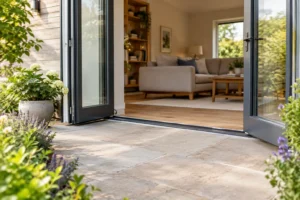
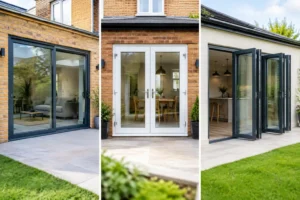
A traffic door is a hinged opening panel built into a bifold arrangement. Instead of operating all the panels together, you can use this one leaf for regular entry and exit. That means easier garden access, less disruption in poor weather, and less need to move the entire stack when you only want a quick way through.
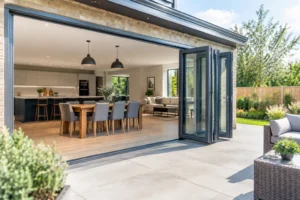
In a typical kitchen extension or rear living space, this is often one of the most useful features in the whole door design. Bifolds are chosen for wide openings, light and a strong connection to the garden, but everyday convenience still matters. A traffic door gives you both.
You may also hear it described as a daily access door or master door. The principle is the same. It is the panel designed for frequent use when the full opening is not needed.
Why traffic doors matter in real homes
A bifold door system can transform a room, particularly where you want clear views and a wide opening in summer. But most people do not spend every day folding all the panels away. More often, they are popping outside, ventilating the room, or walking through with children, pets or shopping bags.
That is where a traffic door earns its place. It gives you the feel of a conventional back door within a much larger glazed system. You keep the visual appeal of slim aluminium framing and large glass areas, but the day-to-day use becomes much simpler.
This matters even more in British homes, where the weather is changeable and outdoor access needs to be practical all year round. Opening one leaf is quicker, helps reduce heat loss compared with opening the full set, and can feel more secure and manageable in winter.
How a traffic door works in a bifold system
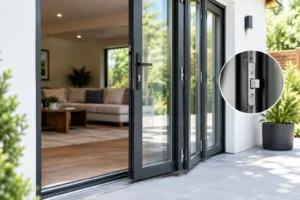
In most bifold configurations, the traffic door sits at one end of the frame, although placement depends on the opening style and layout of the room. It is fitted with its own handle, locking mechanism and hinges so it can operate independently.
When you want full access, the door can still become part of the larger folding action. When you only want to pass through, you use it as a standard door. This dual function is what makes it so useful.
The exact operation depends on the system selected. On products such as Smarts Visofold 1000 Bifold Doors or Smarts Visofold 6000 Bifold Doors, the design can be tailored around practical use as well as the visual finish. The number of panes, opening direction, threshold detail and panel sizes all affect how the traffic door performs.
What are traffic doors useful for?
The clearest answer is convenience, but that convenience shows up in several ways.
If your bifolds open from a kitchen diner onto the garden, a traffic door gives straightforward access for everyday use. You can let fresh air in while keeping the main set closed, move between inside and outside during family gatherings, or step onto the patio without the effort of opening every panel.
It also helps if your bifolds are your main rear entrance. In many extensions, bifold doors replace what used to be a standard external door, so having one leaf that behaves like a regular door is often the most practical arrangement.
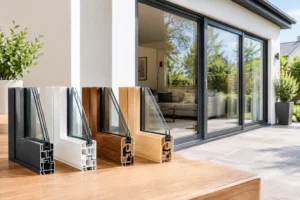
For homeowners focused on energy efficiency, there is another benefit. Aluminium systems with a thermal break and energy efficient glazing are designed to help retain warmth, but opening a full wall of doors in January is not ideal if you only need a quick route outside. A traffic door reduces that issue.
Is a traffic door always the right choice?
Not always. It depends on how you plan to use the space.
If your bifolds are mainly there for entertaining and you expect to open the full aperture on warm days, a traffic door is usually still worthwhile, but the design should be carefully planned so it does not compromise the panel arrangement you want. In some layouts, particularly where symmetry is a priority, homeowners may prefer a configuration that focuses on balanced sightlines over daily access.
There are also cases where sliding doors may suit the room better. If the opening is very wide and your main priority is uninterrupted glass with minimal frame lines, a system such as the Smarts Visoglide Plus sliding door or Cortizo COR Vision Sliding Door may offer a better fit. Sliding doors do not include a traffic door in the same way, but they can be easier to use for regular access because one panel simply slides behind another.
This is why the best choice is rarely about one feature on its own. It is about how the whole door set supports the way you live.
Traffic doors and security
Security is another reason traffic doors matter. A properly specified traffic door should include the same high standard of locking and hardware you would expect from the rest of the bifold system. Top-of-the-range security should not be treated as an upgrade for a frequently used door leaf. It needs to be standard.
Because this is the panel most likely to be used every day, the quality of the handle, cylinder, hinges and multi-point locking system all matter. A well-made aluminium bifold set combines secure hardware with the natural strength of the frame, helping homeowners feel confident whether they are at home or away.
This is also where professional specification makes a difference. The position of the traffic door, threshold option and opening direction should all be considered alongside security and ease of use, not as separate decisions.
Thresholds, access and practical design
A traffic door is only as useful as the access it provides. If you want smooth movement between kitchen and patio, the threshold deserves just as much attention as the panel layout.
A low threshold can make a traffic door more comfortable for daily use, particularly for children, older family members or anyone moving in and out with pushchairs or garden items. At the same time, threshold selection must still account for weather performance and Building Regulations.
This is where bespoke design is valuable. The right answer depends on floor levels, drainage, exposure and how the room connects to the outside. There is no one-size-fits-all option, especially in renovation projects where existing openings vary.
Choosing the right traffic door position
The best position depends on the room, furniture layout and how you naturally move through the space.
For some homes, the traffic door works best nearest the kitchen so it becomes the main route to the garden. In other layouts, placing it at the opposite end gives a cleaner circulation path from dining or seating areas. If the doors are replacing an existing back door, it often makes sense to keep a familiar access point.
This is one of those details that looks minor on a drawing but has a big effect once the doors are in place. It is worth thinking about where people will stand, walk and reach every day, not just how the set looks fully opened on a sunny afternoon.
What to ask before you order
If you are comparing bifold options, ask whether the quoted configuration includes a traffic door, how it operates, and whether it opens in or out. Check how it affects threshold choice, panel stacking and usable opening width.
You should also ask about thermal performance, security hardware and whether the system is being made to suit your opening rather than adapted to a standard size. Bespoke aluminium systems are usually the best way to balance appearance and function, particularly in extensions and refurbishment projects.
For homeowners choosing between supply-only and installation, clear technical advice is especially important. A traffic door sounds simple, but its success depends on good design, accurate measuring and the right product specification from the outset.
At Smarts Bifold Doors, this is usually where the conversation becomes most useful – not simply choosing a style, but making sure the configuration matches how the space will actually be used.
A traffic door is not the headline feature people talk about when they imagine new bifolds. That tends to be the light, the view and the wide opening. But once the doors are in, it is often the feature that makes the whole system feel easier, smarter and better suited to everyday life.